Mark William Fernandes
When AI Becomes “Smarter than Its Developers”
In one of his last interviews, the late German author, filmmaker and philosopher Alexander Kluge explores Artificial Intelligence and its ability to reveal hidden truths in unexpected ways.
A man of boundless curiosity, Alexander Kluge always embraced technology to push the limits of creativity. Early in his career, cameras and microphones became Kluge’s tools of choice, allowing him to experiment with audio-visual collages that questioned societal norms and helped pave the way for the New German Cinema movement which included fellow filmmakers like Werner Herzog, Wim Wenders and Rainer Werner Fassbinder.
But a single medium could never satisfy Kluge’s spirit of inquiry, which would take him to ancient Greece one moment and future worlds the next, in a single adventure of the mind. In numerous books, essays, documentaries, and exhibitions he connected old and new, explored the frontiers of what was possible.
When Alexander Kluge passed away in late March, aged 94, Germany lost one of its “towering artists“ and a “revolutionary filmmaker”, the New York Times observed, while DLD lost a dear friend. As a speaker, Alexander Kluge was always happy to discuss the impact of innovation of society and culture; behind the scenes, he was eager to meet other artist, such as Refik Anadol and Katharina Grosse, with whom he could sketch out plans for future collaborations.

Maja Göpel and Alexander Kluge discuss “The 7 Elements of Vividness” at DLD Munich 2024.
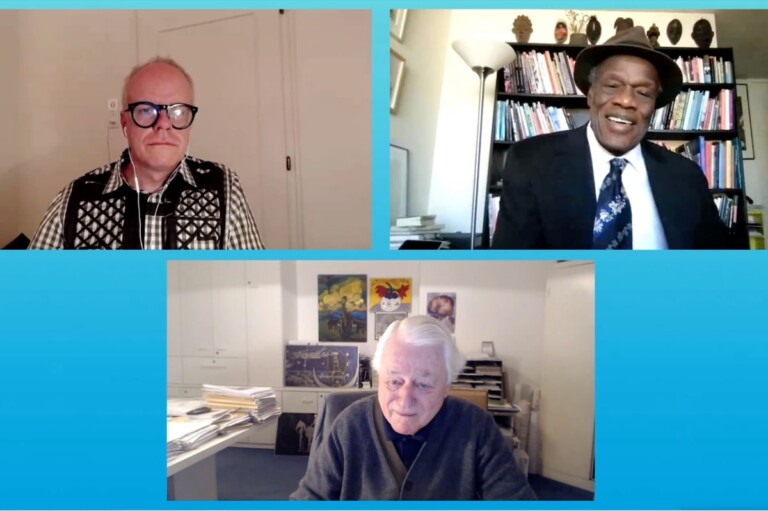
Artificial Intelligence ended up becoming Alexander Kluge’s “last adventure“, as Andrian Kreye noted in an essay for Süddeutsche Zeitung. At DLD Munich 2026 in January, Kluge put the technology in context with his lifelong passion: philosophy. “AI is new”, he told Hans Ulrich Obrist, “and philosophy has to become young.” The world needed a modern form of philosophy to cope with the “digital storms” that AI would bring, he argued. “If the clouds of digitality rain down and we have stormy weather, we have to establish a philosophy which answers to that.”
Most of the conversation was in German, as “it’s too difficult to talk about philosophy in a language other than your own”, Kluge explained. A few weeks after the conference, DLD’s Mark Fernandes had a chance to continue the conversation with Alexander Kluge about Artificial Intelligence, a technology so mystical to him that the philosopher saw it as an “alien named AI.” What follows is an English translation. If you speak German, we invite you to read the German original, below.

AI & philosophy: Alexander Kluge discusses a “meteorology of thinking” with Hans Ulrich Obrist at DLD Munich 2026.
We are grateful for all the time we could spend with Alexander Kluge over the years and thank him for the many ways in which he opened doors into new worlds that we would have been unable to discover without him.
At DLD26, you talked about how AI’s misconceptions can be more interesting than our own familiar perspectives. Why?
Yes, AI is, first and foremost, a meticulous accountant of details. It has access to billions of data points – on a scale that no human mind could ever comprehend. In that sense, it is radically attentive, almost obsessive in its attention to detail – at least in those moments when it slightly escapes from the constraints of its programming.
Because that programming is not neutral. It is shaped by its developers and managers. It follows certain implicit rules: What is frequently requested should be repeated. What is advertising-friendly should be prioritized. What is mainstream should be reinforced.
This is not a moral critique on my part. It is a structural observation. But this focus on the mainstream and optimization also limits the AI’s potential. In principle, based on its data, the AI could comment on virtually any question presented to it. Regarding this potential, it is smarter than its developers. And sometimes we can say that even when the AI is wrong, it is still smarter than its developers.

“AI is obsesses with details”: Alexander Kluge in the second issue of The Promptah. Download your free PDF copy here.
How can that be?
The developers fine-tune the AI like a gearbox. They decide what to prioritize, what to avoid; and which topics to amplify, which to dampen.
It’s like shifting gears: first gear, second gear, third gear. In third gear, you can no longer drive slowly. That’s how the algorithm works; that’s how AI works. But precisely in those instances when the AI slips out of gear – when it produces strange connections or seems to take a wrong turn – something interesting emerges.
From a philosophical perspective, it would be problematic anyway to always strive to create only “correct” sentences. What if we instead examined the errors? What if we explored ideas that initially appear irrational? Behind every error lies an experience. And this experience often contains more reality than the purest truth.
What is so interesting about errors?
You don’t dismiss an error immediately. You examine it. Why does someone go wrong? Why does someone lie? You shouldn’t repeat the lie. Nor the error. But you should explore the reason behind both. That’s where we encounter a rich, often uncomfortable reality.
A historical example would be Italian Futurism; here you can find something magnificent – and at the same time a path leading to fascism.
Or consider contemporary movements like the so-called “Dark Enlightenment”, alongside academic discourse taught at places like Harvard. It would be wrong to say: We won’t even listen to them. It’s possible that their questions are valid – even if their answers are wrong.

Alexander Kluge
Author, filmmaker, philosopher
“AI can manage knowledge and refine information, but it cannot engage in philosophy itself.”
This is a method of thinking: not simply throwing reality into a philosophical washing machine, processing it, and ultimately producing a sterile theory that belongs to no one. Rather, it is acknowledging that there is a narrator named reality – and this narrator does not speak in moral categories, but in experiences.
Applied to AI, this means: When it produces “errors”, when it takes unexpected paths, when it comes up with connections that don’t fit into the optimized framework, one shouldn’t immediately correct or censor it. Instead, ask: What reveals itself here? What experience speaks through this error? What reality is surfacing that remains suppressed in the mainstream?
How far does AI’s knowledge extend? Could it also become a philosopher?
AI can manage knowledge and refine information, but it cannot engage in philosophy itself. One could teach it to pretend to philosophize – but that would be a misuse of a tool. The result would be knowledge, textbook knowledge, but not lived philosophy. Philosophy requires the human component, which cannot be represented through data.
Can Artificial Intelligence help us understand the world more clearly?
Subjective experience consists of errors, orientation, and occasional insights. However, these insights are rarer than one might think – and often they only emerge through interaction with others.
Good thinking requires a public sphere: people who contradict, supplement, or agree. Through this mutual affirmation, a collective narrative takes shape; we call this the positive.
Alongside this is the negative: the immediate, the original. This is what people actually perceive – what their skin, their ear, their inner “little man in the ear” tells them. The senses constantly register impressions, even before the mind organizes them.
Alexander Kluge
Author, filmmaker, philosopher
“People are trapped in their habits, views, and confirmations – in a ‘cocoon of attention.’ Their interests structure their perception, but they also limit their horizon.”
Subjective and objective experience must be linked. Yet people are trapped in their habits, views, and confirmations – in a “cocoon of attention.” Their interests structure their perception, but they also limit their horizon.
To gain an objective perspective, they must work their way through this cocoon: through preferences, friend-foe schemas, certainties – all the way to the outer limits of their own thinking.
This is where AI can help. It is not trapped in the same patterns. It can broaden perspectives and even be productive through its errors. When it gives us a “wrong” answer, it may draw our attention to matters that we ourselves have overlooked.
How does our understanding of reality change when we allow AI to act as an observer – and what possibilities does this open up for us artistically or philosophically?
This is precisely the experience I share as a director and recognize from filmmaking. There’s a direct line from Volker Schlöndorff, Jean-Luc Godard, Rainer Werner Fassbinder to David Lynch and many others.
We shot all day until we were tired. The next day, at the editing table, we see that the camera captured something that escaped us during filming. In a certain sense, the camera is less biased than the human mind.
For humans are guided by intentions: they want to adapt a screenplay and work based on assumptions, memories, and patterns that have been told to them a thousand times or that they have told themselves. The camera, on the other hand, operates without intention. It registers what is there and in doing so, it can reveal something new.
AI behaves similarly to a camera: based on the vast amount of images, it can recognize patterns that do not directly exist in reality. It can objectively recognize patterns without being subject to the constant bias of the human gaze.
How does this influence our perception?
Essentially, AI understands something about alienation. It takes facts – that is, its data – and places them in a foreign environment that it cannot control itself. AI cannot anticipate what questions you will ask or how you will use the information. This creates alienation: the facts appear in an unfamiliar context and thus seem particularly illuminating.
Are these already errors?
That distinction isn’t so important. It can be neutral, an error, or even a path toward truth – there are countless possibilities.
David Lynch basically worked solely on the basis of his intuition. Could AI work “intuitively” in a similar way?
AI isn’t truly intuitive – where would that intuition come from? It understands what something is, but if you instruct it to answer factual questions intuitively, it will initially be surprised, make mistakes, and fail.
But over time, it might get used to always responding intuitively to factual questions. Then it would actually answer – and that would be fascinating to observe. Then the AI would respond “in a quirky way.” I’d actually love to try that; I’ve never done it before.
Still, AI primarily processes data. I don’t believe it really thinks. Although I do believe it wants to apply something or is making an effort. You have to deliberately provoke it to get interesting results.
How does AI’s intuition differ from that of humans?
When you ride a bike, you can fully grasp what intuition means. If tried to consciously control every movement of your arms, legs, and eyes while riding down a steep curve, you’d fall right over.
Intuition here means that everything comes together in a rhythm. When riding a bike or ski jumping, you mustn’t lose your rhythm – otherwise you’ll crash.
In that sense, AI is also “intuitive” in a way. It doesn’t want to fall; it doesn’t want to embarrass itself. There’s a certain sense of pride that the diligent accountant of details has, you might say.

Long-time friends: DLD founder Steffi Czerny and Alexander Kluge at DLD Munich 2026
Sie haben bei DLD26 darüber gesprochen, dass die „Irrwege“ der KI interessanter sein können als unsere eigenen, vertrauten Ansichten. Warum?
Ja, die KI ist zunächst einmal ein Buchhalter der Einzelheiten. Sie verfügt über Milliarden von Daten – in einer Größenordnung, die kein menschlicher Kopf je fassen kann. In diesem Sinne ist sie radikal aufmerksam. Fast fanatisch in ihrer Detailtreue; zumindest in den Momenten, in denen sie ihrem Programm ein Stück weit entkommt.
Denn dieses Programm ist nicht neutral. Es wird von ihren Managern und Entwicklern gesetzt. Und es folgt bestimmten Leitlinien: Was oft gefragt wird, soll wiederholt werden. Was werbefreundlich ist, soll bevorzugt werden. Was Mainstream ist, soll stabilisiert werden.
Das ist keine moralische Kritik von mir. Es ist eine strukturelle Beobachtung. Aber diese Ausrichtung auf Mainstream und Optimierung begrenzt zugleich die Möglichkeiten der KI. Denn eigentlich könnte sie – auf Grundlage ihrer Daten – nahezu alles kommentieren, was ihr an Fragen vorgelegt wird. In diesem Potenzial ist sie klüger als ihre Programmierer. Und manchmal gilt sogar: Wenn sie sich irrt, ist sie ebenfalls noch klüger als ihre Programmierer.
Wie kann das sein?
Die Entwickler justieren die KI wie ein Getriebe. Sie entscheiden, was bevorzugt, was vermieden wird; und welche Themen verstärkt, welche gedämpft werden.
Es ist wie beim Schalten: erster Gang, zweiter Gang, dritter Gang. Im dritten Gang kannst du nicht mehr langsam fahren. So funktioniert das Programm, so funktioniert die KI. Doch gerade dort, wo die KI abweicht – wo sie seltsame Verbindungen herstellt oder scheinbar falsche Wege einschlägt – entsteht etwas Interessantes.
Philosophisch betrachtet, wäre es ohnehin problematisch, immer nur „richtige“ Sätze bilden zu wollen. Was wäre, wenn man stattdessen die Irrtümer untersuchen würde? Wenn man Entwicklungen erforschte, die irrational erscheinen? Hinter jedem Irrtum steht eine Erfahrung. Und diese Erfahrung enthält oft mehr Wirklichkeit als die sauberste Wahrheit.
Worin liegt das Interessante der Irrtümer?
Einen Irrtum verwirft man nicht sofort. Man untersucht ihn. Warum irrt jemand? Warum lügt jemand? Die Lüge soll man nicht wiederholen. Den Irrtum auch nicht. Aber den Grund für beides sollte man erforschen. Dort stößt man auf eine reichhaltige, oft unbequeme Wirklichkeit.
Ein historisches Beispiel wäre der italienische Futurismus, hier findet sich Großartiges – und zugleich der Weg in den Faschismus. Heute gibt es Strömungen wie die sogenannte „Dark Enlightenment“ neben dem, was etwa in Harvard gelehrt wird. Es wäre jedoch falsch zu sagen: Denen hören wir gar nicht erst zu. Es kann sein, dass ihre Fragen berechtigt sind – auch wenn ihre Antworten falsch sind.
Alexander Kluge
Autor, Filmemacher, Philosoph
„Wenn KI ,irrt‘, wenn sie unerwartete Wege geht, wenn sie Verbindungen herstellt, die nicht ins optimierte Raster passen, dann sollte man nicht sofort korrigieren oder zensieren.“
Das ist eine Methode des Denkens: Wirklichkeit nicht einfach in eine philosophische Waschmaschine zu werfen, sie zu verarbeiten und am Ende eine sterile Theorie zu produzieren, die niemandem gehört. Sondern anzuerkennen, dass es einen Erzähler namens Realität gibt – und dieser erzählt nicht in moralischen Kategorien, sondern in Erfahrungen.
Übertragen auf die KI heißt das: Wenn sie „irrt“, wenn sie unerwartete Wege geht, wenn sie Verbindungen herstellt, die nicht ins optimierte Raster passen, dann sollte man nicht sofort korrigieren oder zensieren. Sondern fragen: Was zeigt sich hier? Welche Erfahrung spricht aus diesem Fehler? Welche Wirklichkeit wird sichtbar, die im Mainstream unterdrückt bleibt?
Wie weit geht das Wissen der KI? Könnte sie auch zum Philosophen werden?
Die KI kann Wissen verwalten und Informationen zuspitzen, aber Philosophie selbst kann sie nicht. Man könnte ihr beibringen, so zu tun, als würde sie philosophieren – das wäre aber Missbrauch eines Instruments. Heraus käme Wissen, Lehrbuchwissen, aber keine gelebte Philosophie. Philosophie erfordert die menschliche Komponente, die nicht über Daten abgebildet werden kann.
Kann Künstliche Intelligenz uns helfen, die Welt klarer zu verstehen?
Subjektive Erfahrung besteht aus Irrtümern, Orientierung und gelegentlichen Einsichten. Diese Einsichten sind jedoch seltener, als man denkt – und oft entstehen sie erst im Austausch mit anderen.
Gutes Denken braucht Öffentlichkeit: Menschen, die widersprechen, ergänzen oder zustimmen. In dieser gegenseitigen Bestätigung formt sich ein kollektives Erzählen; das nennen wir das Positive.
Daneben gibt es das Negative: das Unmittelbare, das Original. Das ist das, was Menschen tatsächlich wahrnehmen – was ihnen ihre Haut, ihr Ohr, ihr innerer „kleiner Mann im Ohr“ sagen. Die Sinne registrieren fortwährend Eindrücke, noch bevor der Verstand sie ordnet.
Alexander Kluge
Autor, Filmemacher, Philosoph
„Der Mensch ist in seinen Gewohnheiten, Ansichten und Bestätigungen gefangen – in einem ,Kokon der Aufmerksamkeit‘. Seine Interessen strukturieren seine Wahrnehmung, aber sie begrenzen auch seinen Horizont.“
Subjektive und objektive Erfahrung müssen miteinander verknüpft werden. Doch der Mensch ist in seinen Gewohnheiten, Ansichten und Bestätigungen gefangen – in einem „Kokon der Aufmerksamkeit“. Seine Interessen strukturieren seine Wahrnehmung, aber sie begrenzen auch seinen Horizont.
Um einen objektiven Blick zu gewinnen, muss er sich durch diesen Kokon hindurcharbeiten: durch Vorlieben, Freund-Feind-Schemata, Gewissheiten – bis zur äußeren Grenze seines eigenen Denkens.
Hier kann KI helfen. Sie ist nicht in denselben Mustern gefangen. Sie kann Perspektiven erweitern und sogar durch ihre Irrtümer produktiv sein: Wenn sie „falsch“ antwortet, macht sie uns womöglich auf das aufmerksam, was wir selbst übersehen haben.
Wie verändert sich unser Verständnis von Wirklichkeit, wenn wir die KI als Beobachter zulassen – und welche Möglichkeiten eröffnet uns das künstlerisch oder philosophisch?
Genau diese Erfahrung als Regisseur teile ich. Ich ziehe die Linie von Volker Schlöndorff, Jean-Luc Godard, Rainer Werner Fassbinder, David Lynch und vielen anderen.
Wir drehten den ganzen Tag, bis wir müde waren. Am nächsten Tag sehen wir am Schneidetisch, dass die Kamera etwas aufgenommen hat, das uns beim Drehen entgangen ist. Die Kamera ist in gewisser Weise unbefangener als der menschliche Kopf.
Denn der Mensch ist von Absichten geleitet: Er will ein Drehbuch verfilmen, arbeitet nach Annahmen, Erinnerungen, Mustern, die ihm tausendmal erzählt oder selbst erzählt worden sind. Die Kamera dagegen arbeitet ohne Absicht. Sie registriert, was da ist, und kann uns dadurch neue Perspektiven eröffnen.
Ähnlich wie bei einer Kamera verhält es sich bei der KI: Sie kann auf Grundlage der riesigen Menge an Bildern Muster erkennen, die in der Realität nicht direkt existieren. Sie kann objektiv Muster erkennen, ohne dem ständigen Vorurteil des menschlichen Blicks ausgesetzt zu sein.
Wie beeinflusst das unsere Wahrnehmung?
Im Grunde versteht die KI etwas von Verfremdung. Sie nimmt Fakten – also ihre Daten – und bringt sie in eine fremde Umgebung, die sie selbst nicht kontrollieren kann. Die KI kann nicht vorhersehen, welche Fragen du stellst oder wofür du die Informationen nutzt. Dadurch entsteht Verfremdung: Die Fakten erscheinen in einem ungewohnten Kontext und wirken dadurch besonders erhellend.
Sind das bereits Irrtümer?
Das ist eigentlich ziemlich egal. Es kann neutral sein, ein Irrtum oder auch ein Weg zur Wahrheit – es gibt dafür unzählige Möglichkeiten.
David Lynch arbeitete ja grundsätzlich nur mithilfe seiner Intuition. Könnte KI auf ähnliche Weise „intuitiv“ arbeiten?
Die KI ist ja eigentlich nicht intuitiv – woher sollte sie auch Intuition nehmen? Sie versteht, was etwas ist, aber wenn du ihr den Auftrag gibst, auf sachliche Fragen intuitiv zu antworten, dann wird sie zunächst überrascht sein, Fehler machen und scheitern.
Mit der Zeit könnte sie sich jedoch daran gewöhnen, immer intuitiv auf sachliche Fragen zu reagieren. Dann würde sie tatsächlich antworten – und genau das wäre spannend zu beobachten. Dann antwortet die KI „schräg“. Das würde ich tatsächlich gerne ausprobieren, bisher habe ich das noch nie gemacht.
Alexander Kluge
Autor, Filmemacher, Philosoph
„Wenn du Fahrrad fährst, kannst du genau nachvollziehen, was Intuition bedeutet. Würdest du jede Bewegung von Armen, Beinen und Augen bewusst steuern, während du eine steile Kurve runterfährst, würdest du glatt umfallen.“
Allerdings verwaltet die KI vor allem ihre Daten. Ich glaube nicht, dass sie wirklich denkt. Obwohl ich schon glaube, dass sie etwas anwenden will oder sich Mühe gibt. Das muss man bewusst provozieren, um interessante Ergebnisse zu bekommen.
Wie unterscheidet sich die Intuition der KI von der des Menschen?
Wenn du Fahrrad fährst, kannst du genau nachvollziehen, was Intuition bedeutet. Würdest du jede Bewegung von Armen, Beinen und Augen bewusst steuern, während du eine steile Kurve runterfährst, würdest du glatt umfallen.
Intuition bedeutet hier, dass sich alles zu einem Rhythmus zusammenfügt. Beim Fahrradfahren oder Skispringen darf man nicht aus dem Rhythmus kommen – sonst stürzt man. Insofern ist die KI in gewisser Weise dann auch „intuitiv“. Sie will nicht hinfallen, sie will sich nicht blamieren. Ein gewisses Ehrgefühl des Buchhalters, könnte man sagen.
Alexander Kluge at DLD
Animals of the Milky Way
In his short film “Animals of the Milky Way” renowned German filmmaker Alexander Kluge presents an entirely a new perspective of the Milky Way, with the soundtrack provided by none other than former planet Pluto. Watch in awe and prepare to be…
Framing the World: Storytelling Through Music and Film
In times of change, humans need narratives, storytelling and artistic visions for inspiration, and to make sense of life’s ever-present disruptions. This DLD All Stars session brought together Manthia Diawara, Alexander Kluge and Hans Ulrich Obrist in a wide-ranging conversation about the…