
Jason Harrell for DLD / Hubert Burda Media
“Sustainability Is a Path to Prosperity”
Prominent climate researcher Johan Rockström discusses how we can best manage planetary risks and reinvent the global economy to create a brighter future.
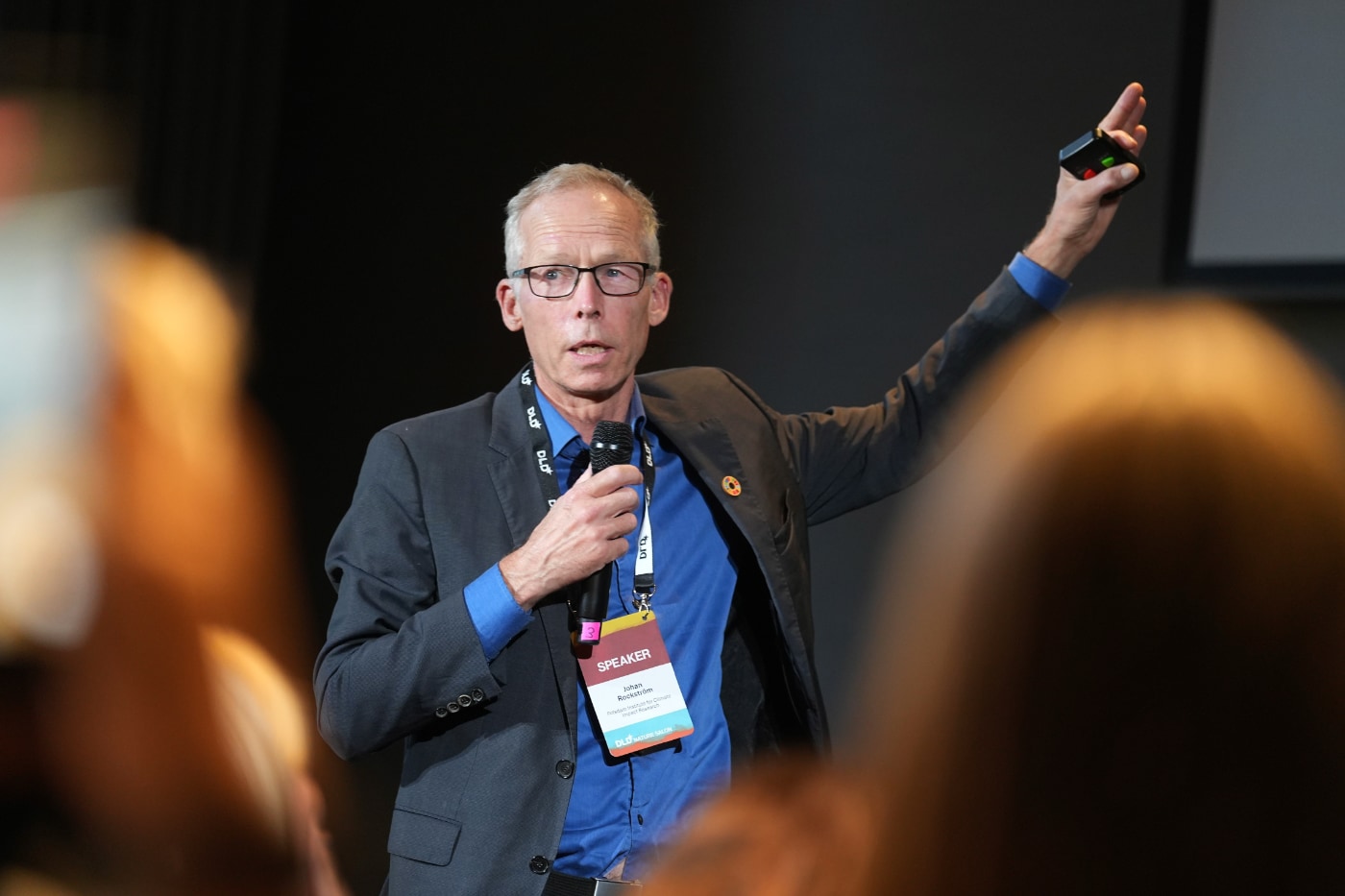
Johan Rockström had a sobering message for the audience of the recent DLD Nature Salon. “We’re still sliding in the wrong direction”, said the Director of the Potsdam Institute for Climate Impact Research (PIK) as he presented results from the 2026 Planetary Health Check report, which he co-edited. The project is an annual assessment of Earth’s vital signs, from global warming to biodiversity, the stability of ocean currents and rainforests, to the state of the ozone layer.
Johan Rockström
is an environmental scientist and Director of the Potsdam Institute for Climate Impact Research (PIK) as well as Professor of Earth System Science at the University of Potsdam. He leads the international team that developed the Planetary Boundaries framework, which defines nine critical Earth-system variables whose disruption poses a risk to the “safe operating space” for humanity.
Speaker Profile
“We take planet Earth to the doctor, go through all the organs, the planetary boundaries”, Rockström explained, and current results show that “we’re outside of the safe operating space.” That doesn’t mean it’s too late to act, he emphasized. But changing the way we do business, protecting nature, and seeing it as an asset – rather than a resource that can be endlessly exploited – was more urgent than ever, Rockström said: “If we don’t turn around the curves within the next years to a decade, we are very likely to push ourselves into unmanageable outcomes.”
In an extensive interview with DLD, the internationally renowned environmental scientist explains why he’s so concerned – but also where the opportunities lie to create a better future, for humans and the planet, by rethinking the way we do business. You can also watch his DLD Nature Salon presentation right here.
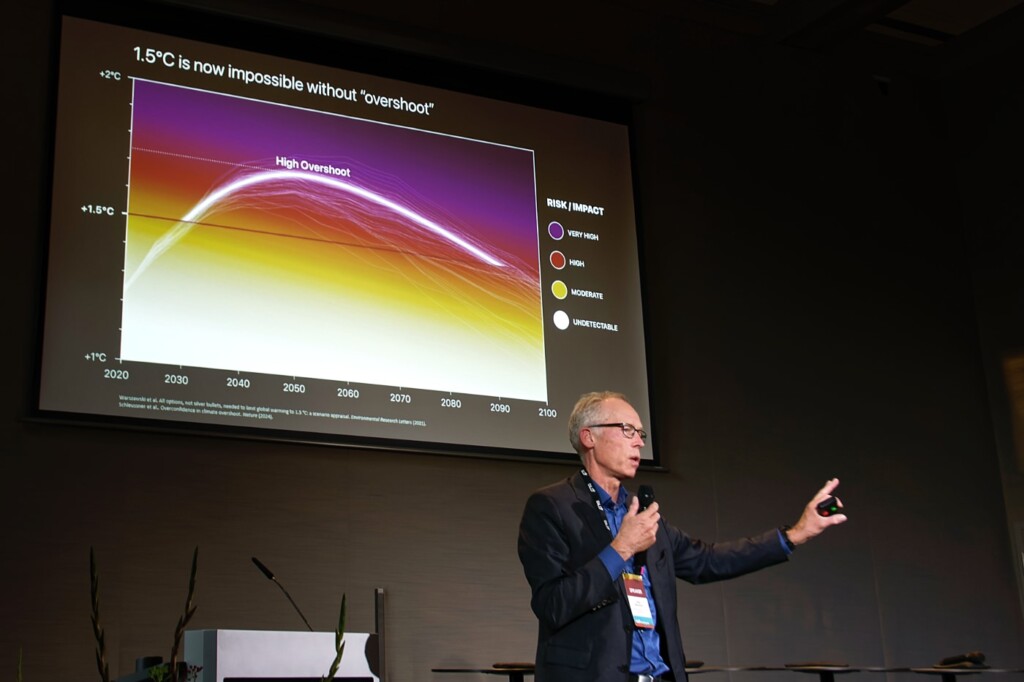
Red alert: “We’re heading inevitably towards overshoot within the next three to five years, exceeding the 1.5 degrees Celsius limit”, Johan Rockström warned in his DLD Nature Salon presentation. (Photo: Karsten Lemm)
When you look at the state of our planet, what do you see?
We are as climate scientists really concerned. Actually, during my whole professional life I have never had reason to be as concerned as today.
The reason is dual. One is that we are at 1.26 degrees Celsius, a global mean surface temperature rise on a 10-year average. And in 2024, we’ve even scratched at 1.5 degrees. We are facing an accelerated rate of change in warming – in the past decade, it has been going faster than before.
But we also must admit that the frequency and amplitude of extreme events are increasing faster than we had expected. So droughts, floods, heat waves, particularly life-threatening heat waves, are at a pace where you could argue that we have underestimated risk. That is one reason for concern.
Planetary Wellbeing: Watch Johan Rockström discuss the latest Planetary Health Check report in his DLD Nature Salon presentation.
What else concerns you?
The second reason is even more serious: It’s that the planet is losing resilience. We’re starting to see signs of a weaker capacity of the planet to buffer and dampen the stress caused by us humans – both in terms of greenhouse gas emissions, but in particular in eroding the biosphere, biodiversity, all ecosystems on land and in the ocean.
We’ve now come to an understanding that planet Earth is this complex interactive system where all the biophysical systems on Earth – from the living ecosystems to the ice sheets to the ocean – interact and have feedbacks that either dampen or self-amplify.

Johan Rockström
Potsdam Institute for Climate Impact Research
“If we cross tipping points, that would cause irreversible loss. And it would be unstoppable.”
And the separation between these feedbacks are tipping points. We now see that the big forest systems – the temperate forest, the boreal forest, the tropical forest – are showing signs of losing their carbon uptake capacity. They’re changing hydrology. The ocean is warming faster than we had expected, the entire North Atlantic overturning circulation, the AMOC, is showing signs of weakening. These are early signs potentially hinting at instability, but they make us really concerned that we are approaching tipping points.
What happens if we cross them?
If we cross tipping points, that would cause irreversible loss – not only loss of human well-being and nature’s contributions to people, but it would also take us on a journey of a less and less livable planet. And it would be unstoppable. It would be a path towards something that is not only irreversible but can take us to unmanageable positions.
When you combine all of the above, that’s the diagnostic we see today. That’s why we conclude that seven of the nine planetary boundaries are outside of the safe space. If you put all evidence on the table, the conclusion must be that it’s starting to cost too much already today, in terms of direct impacts. But it’s also starting to come closer to red lines that we simply cannot allow ourselves to cross.
Which are these red lines?
Tipping-point science has advanced to the point where temperature levels for many of Earth’s major tipping elements can now be quantified, though with uncertainty. And several of them are likely to cross the thresholds already at 1.5 degrees Celsius. That includes the Greenland ice sheet, the West Antarctic ice sheet, and all the tropical coral reef systems. These are a massive livelihood base for hundreds of millions of people.
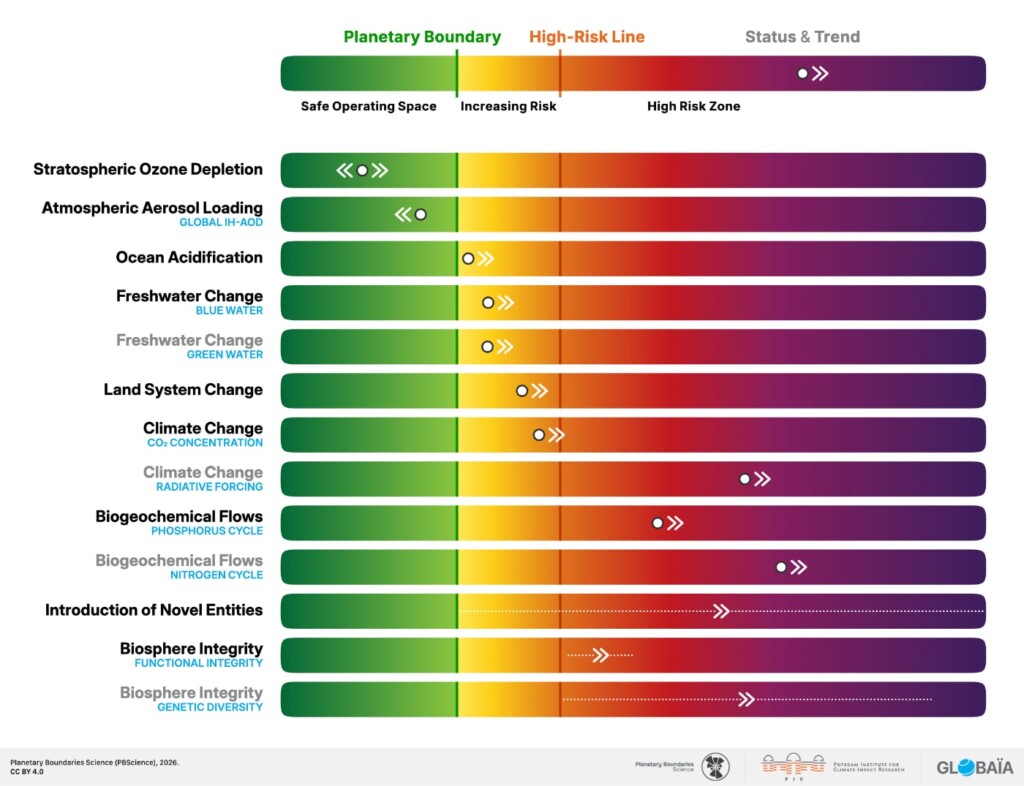
Earth at risk: Seven out of nine planetary health indicators are outside the safe zone, the Planetary Health Check 2026 report shows. (Source file.)
We’re also talking about thawing of permafrost in the boreal zone, such as northern Canada and Siberia, as well as the collapse of the Labrador sea convection. This is one of the convections and currents in the North Atlantic that regulate the whole northern atmosphere’s regional climate – an extremely important system, especially for us in Europe.
What other areas of the world are in danger?
The Amazon basin is increasingly considered to be on the line, if you combine what’s happening with deforestation and biodiversity loss in the context of climate change. The Amazon is planet Earth’s richest land-based ecosystem, and we know with a very high degree of scientific evidence that the rainforest system has multiple stable states. Push the system too far and it will irreversibly tip over and no longer be a rainforest.
A rainforest is called a rainforest because in the Amazon for example, it generates 40 to 50 percent of its own rainfall by recycling water through evaporation and transpiration. That’s the feedback that keeps the whole system moist. Once you destroy that system beyond a certain point, it crosses a tipping point. The forest begins to dry out and it will become a degraded forest moving towards a more savanna-like state.
How likely is this?
From a climate perspective, we put the threshold of that happening in the Amazon at three to five degrees Celsius of warming, at what I would call disastrous warming levels. But when the ecologists look at this research, they say, “You’re wrong.” Because the Amazon rainforest will tip at much lower temperatures if you lose too much biodiversity. This in turn is closely related to deforestation, because when you open up these forest roads in the Amazon rainforest, it looks like a fishbone. You have a main road and then you have many side roads.
Johan Rockström
Potsdam Institute for Climate Impact Research
“Nature is showing signs of losing its buffering capacity. That is why we as scientists are so concerned.”
What this means is that you open up the canopy and you get dry air flowing through, and the whole system evaporates water in a way that dries out the system. You lose the moisture-holding capacity, and that in turn leads to the loss of rainfall generation.
My Brazilian colleague Professor Carlos Nobre, who is arguably the world’s leading expert on the Amazon ecology and its climate system, he says we’re very close to a tipping point in the Amazon. Because our estimates are today that at 22-28 percent of canopy loss, we risk losing the Amazon already at 1.5 to 1.9 degrees Celsius of global warming.
Where are we today?
In 2025, we were at 1.44 degrees Celsius of global warming and 17 percent Amazon forest loss. So however we twist and turn this, my conclusion today is that we are in a climate crisis – but most likely we’re still underestimating the risk because we haven’t fully factored in the interactions with biodiversity, with land use, with the nitrogen and the phosphorus cycle, aerosol cooling, air pollutants.
Biodiversity, the ocean physics, ice sheets, all the land use systems – for more than 150 years, they’ve had a dampening effect on human-induced climate change. But nature is showing signs of losing its buffering capacity. That’s why I’m so nervous about the resilience, that is why we as scientists are so concerned.
What is the most urgent action that we need to take?
There are two things we need to do as a matter of urgency. Number one is, of course, to phase out fossil fuels, cut global emissions in half by 2030, reach net zero by 2050. All Parties to the Paris Agreement have committed to pursue efforts to limit global warming to 1.5°C. It’s agreed upon, now it’s a question of delivery.
Double Crisis: Watch Johan Rockström’s DLD Nature talk about the link between biodiversity and climate change.
The second is to take the global biodiversity framework seriously and halt the loss of biodiversity. If you look at the whole planet, we have transformed roughly 50% of Earth’s land surface. We have converted ecosystems mainly into agricultural land, as well as urban areas, roads and other infrastructure.
But we can no longer expand into intact nature. The urgent decision is “enough is enough”. We simply have to have a global agreement. I would like to see a global moratorium from the United Nations that we can no longer destroy intact nature. It’s a global common. It is what regulates the stability of the planet. It is what dampens a significant portion of the global warming.
Would that work, given the economic and political interests involved?
We simply must halt that loss. We simply have to keep the remaining nature intact. Those are, I would argue, the two most urgent decisions. And the third decision that has to be taken is to transform the global agricultural system. Because we see from all the evidence today that the global food system is the single largest cause for this degrading of the resilience of the planet.
Johan Rockström
Potsdam Institute for Climate Impact Research
“Not only do we have all the evidence, we also have the solutions. It’s a choice for us whether we fail or succeed.”
Industrialized agriculture is the single largest cause for loss of biodiversity, by far the largest consumer of freshwater, overloading of nitrogen phosphorus, biodiversity loss, one third of greenhouse gas emissions. So, fix the food system and we can rapidly be on the right way.
The frustrating thing is: Not only do we have all the evidence, we also have the solutions. And the solutions are well demonstrated. It’s a choice for us whether we fail or succeed. To do sustainable agriculture without expanding into intact nature is absolutely, fully implementable.
Don’t we need our current system in order to produce enough food for all of mankind?
We have enough food for all of mankind. It’s a question of getting rid of a significant portion of food waste. About a third of all food that is produced gets thrown away. And then it’s a question of having a better dietary composition. Reducing red meat consumption would free up a tremendous amount of biomass, and it doesn’t mean we need to give up eating meat. A portion of our diets still can – and in many cases should – come from animal protein.
New Ways in Agriculture: This DLD Nature session explores how to produce food for a growing global population while preserving the environment and biodiversity.
There’s a lot that can be done. Nothing is hindering us. There are so many studies out there that show that we can feed humanity within planetary boundaries if we make more efficient use of nutrients, nitrogen, phosphorus, more efficient use of fresh water. But the biggest concern is biodiversity and land – to preserve nature instead of destroying it for agriculture.
Many people seem tired of hearing about climate change. How can you win them over?
I actually quite strongly disagree. I’m completely convinced that even though it’s uncomfortable information, our biggest mistake is that we are not informing enough. We have to bombard people even more with information.
If you ask a hundred people in the streets about what you mean when you say “1.5 degrees Celsius”, I can promise you that perhaps one or two will know what you’re talking about. That is a huge failure. In my view, that’s the most important number in the world. And despite all the work and all the communication, people still don’t know what it is. It’s uncomfortable, but the communication has to just increase.
Why do you feel the message isn’t getting through?
We have failed in the way we communicate the existential risk we’re facing. It still comes across as if we have to back off and sacrifice and there’s a cost to it. “No flights, no meat, life is not fun anymore.”
Johan Rockström
Potsdam Institute for Climate Impact Research
“The sustainable journey today is a journey towards a more modern, attractive future.”
So it’s either a good life or a sustainable life. That is, of course, a complete misnomer. It’s completely incorrect. Actually, today, we know that the sustainable transition creates a future which is healthier, it is more peaceful, it creates more jobs and boosts the economy.
For Germany’s car industry, the challenge is no longer whether to embrace electrification, but how to remain competitive in a global market that is rapidly moving towards electric mobility. Clinging to the combustion engine will not protect German jobs in the long run; investing in innovation, electrification and the technologies of the future will. The sustainable journey today is a journey towards a more modern, attractive future.
What’s the best way to manage this economic shift?
Business as usual is a dead end. You can argue that point from so many perspectives. It’s not only about climate and biodiversity. It’s also about ensuring a minimum level of dignified life for a global population well above eight billion people. Without more efficient circular resource use, smarter ways of reducing our linear production systems, and better ways of taking care of nature and urban areas – it’s a dead end.
You could argue that, yes, the sustainability journey is not simple. We’ve had 150 years of moving in the wrong direction, and now we’re going to change direction. It’s a big transformation.
Of course, there will be winners and losers, it’s a bumpy transition. We’ll all be winners in the long run, but it’s a transition. What we have to be clear on is that continuing as we do today will make us all losers. You might have a few joyful days in the beginning, but by the end, what you leave for your kids is actually a less attractive future – locally, regionally, globally. So we need to change, and the narrative has to change. Sustainability is a path to prosperity. And if we make that clear, people will come along.
Related Posts
Saving Planet Earth: The Case for Immediate Action
From climate change to biodiversity loss, all warning signs are flashing red. Experts explain how we can break the cycle, regenerate nature and shape a better future for us all.
Investing in Nature: Building a Business Case to Save the Planet
Three leading experts from science and business discuss nature’s value for the global economy, highlighting the critical need to invest in nature conservation – because biodiversity loss is as significant a threat as climate change. Moderated by Solveigh Hieronimus (McKinsey & Company),…
