
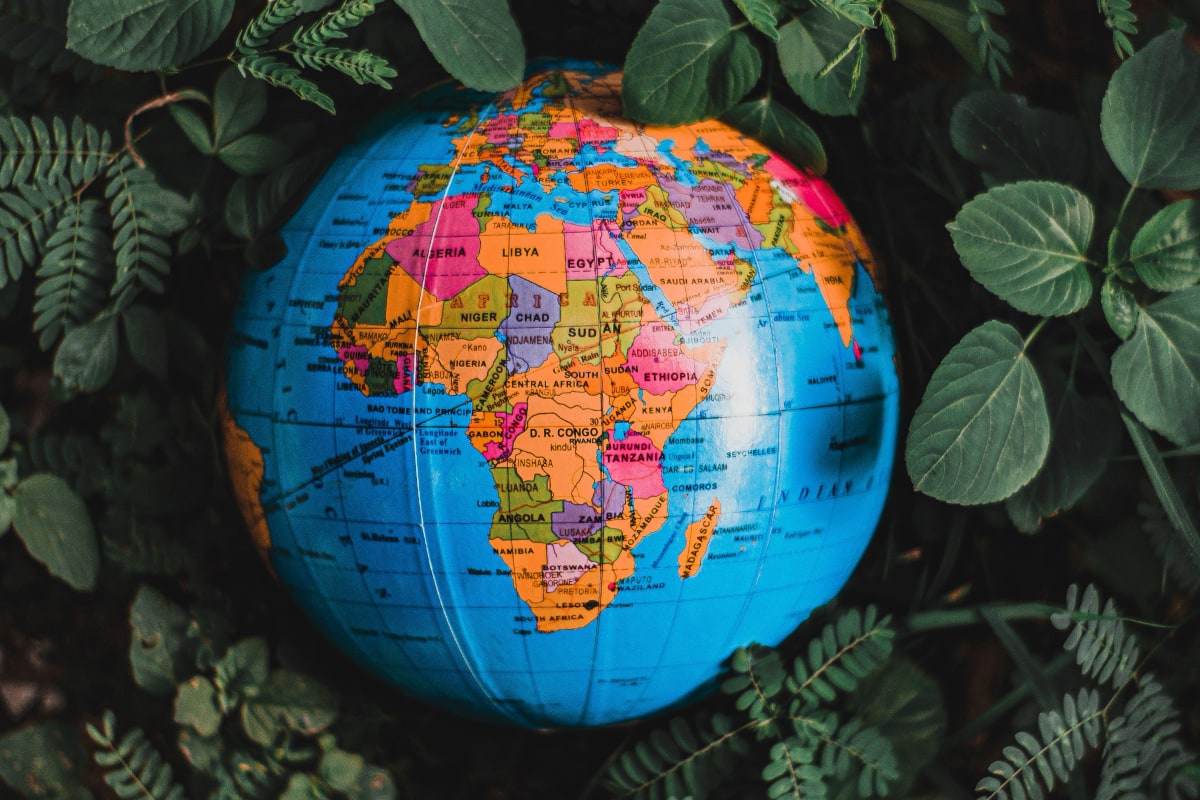
Ian Panelo/Pexels
Saving Planet Earth: The Case for Immediate Action
From climate change to biodiversity loss, all warning signs are flashing red. Experts explain how we can break the cycle, regenerate nature and shape a better future for us all.
“Do insects like art?” This may sound like an odd question, but trying to find an answer turned out to be hugely beneficial for animals and humans alike, as the success of Alexandra Daisy Ginsberg’s project “Pollinator Pathmaker” shows. One of her works was on display at the recent DLD Nature Salon in Berlin, where Ginsberg collaborated with the LAS art foundation to revitalize a piece of land in front of the city’s Museum for Natural History, the venue of the event.
Many attendees had probably not noticed anything special about the garden, “walked through an artwork and didn’t see it”, Ginsberg said. “But it’s not for you, and that’s really the point.” Typical gardens are designed to please humans. Ginsberg’s project tries to answer the question: “What would it mean to experience the world from the perspective of pollinators?”
Originally commissioned in 2020 by the Eden Project in Cornwall, UK, the idea of creating gardens specifically for bees, butterflies, beetles and other pollinators has taken root all over Europe – in the form of commissioned artworks as well as community gardens. In Berlin, the British artist transformed a “courtyard that was dead, apart from a few trees, into this place humming with life.” Researchers have spotted more than 80 species of bees – many of them rare – buzzing around the new “it” place for insects in Germany’s capital.
Changing perspectives: Watch artist Alexandra Daisy Ginsberg discuss her project “Pollinator Pathmaker” with Bettina Kames, director of the LAS art foundation.
“It’s so simple”, Ginsberg says. “We just planted an artwork, and the insects came.” Her project illustrates a core message of the event: Nature has a surprising ability to recover – provided humans give it a chance and are willing to invest in what is arguably the most important resource on Earth: the health of our planet.
Let’s take a look at key takeaways from the DLD Nature Salon. You can find further talks in our Youtube playlist of the event.
Putting Nature on the Balance Sheet
By some estimates, more than half of the world’s economic output depends on nature’s services. Protecting crucial resources – such as rainforests, rivers and fertile soil – should therefore be a top priority for any manager and politician. The trouble is that nature’s benefits are invisible to Chief Financial Officers and Ministers of Finance. “And if it’s invisible, you can’t price it”, Valerie Hickey, Director for Environment at the World Bank Group pointed out in conversation with Ma Jun (Institute of Public & Environmental Affairs), Jürgen Kern (KfW Group) and Martin Stuchtey (The Landbanking Group).
One way to change that is natural capital accounting, which treats planetary resources as an essential asset for society and the global economy. For a long time, the challenge was finding out how big these contributions are. But this has changed. “We are able to measure nature”, Martin Stuchtey emphasized. A range of technologies, such as soil image recognition, bioacoustics and remote sensing “allow us to give every pixel of the planet an ecological identity.”
Rethinking finance systems: Valerie Hickey (World Bank) discusses nature’s capital with Ma Jun (Institute of Public & Environmental Affairs), Jürgen Kern (KfW Group) and Martin Stuchtey (The Landbanking Group).
This in turn makes it possible to give nature a value and “build a healthier balance sheet”, he emphasized. Protecting ecosystems or improving biodiversity could be shown to benefit the overall economy, he argued. “That allows us to present nature as something to invest in, an opportunity for the future”, Stuchtey said. “You will get used to words like ‘nature stocks’, ‘nature asset companies’ or ‘essential infrastructure projects’”, he predicted.
Food, Security and Stability
In the face of too many international conflicts and geopolitical crises, biodiversity loss and climate change may appear to be less urgent risks to deal with. But that impression is wrong, Richard Nugee, a safety and environmental adivser to the British government, emphasized in conversation with entrepreneur Anna Alex. “There’s war all over the world. But the threats to Europe, and the threats to the U.K. particularly, are just as relevant from nature loss and climate change”, said Nugee, a former Lieutenant General in the British Army.
Already, global warming has started to wreak havoc with food security and health, he pointed out: tropical diseases like Dengue fever are becoming common all across Europe, while droughts, heat waves and wildfires threaten lives, destroy crops and diminish harvests. “Agriculture in Europe is becoming increasingly difficult”, Nugee warned. One reason: the rapid increase of water temperatures in the Mediterranean, which “is heating up at four times the rate of the oceans because it’s effectively a lake.”
The best answer to the challenge was a combination of preparation and adaptation, Nugee argued. He sees food as a key issue because it‘s easily relatable and key to the stability of any nation. When the daily meal becomes unaffordable, “that’s a security issue which we want to avoid”, Nugee said, pointing to history, from the French Revolution to the Arab Spring. At the same time, food security was an excellent way to explain the importance of dealing with climate change and biodiversity loss. “Everything that I’m doing is trying to relate to the person in the street”, Nugee said. “Go to where people are interested”, he advised, “and then say: ‘This is the effect it’s going to have on you!’”
Nature and national resilience: Watch Richard Nugee, member of the Ministerial Taskforce on Climate and Security of the U.K. Government, in conversation with entrepreneur Anna Alex.
Tipping Points
For scientists, there’s no doubt that Earth may become a planet hostile to humans unless we find ways to dramatically reduce greenhouse gas emissions and protect vital ecosystems. “There is no safe future only by getting off oil, coal and gas”, Johan Rockström, Director of the Potsdam Institute for Climate Impact Research (PIK), told the audience. “We also need to secure the biodiversity and ecological functions in the Earth system.”
Time is running out to finally take action, Rockström made clear as he presented findings from the latest Planetary Health Check report. “The curves continue moving in the wrong direction”, he warned. “We haven’t even bent the curves yet.” From pollution to land use, fresh water availability and ocean acidification: seven out of nine planetary boundaries have been breached, the report shows. “If you put all this together, we place the planet outside of the safe space”, Rockström emphasized. “We’re in danger.”
Further ignoring nature’s warning signs is extremely risky, as fragile planetary systems can suddenly collapse when they cross tipping points. These are “systems that are life support for essentially the entire global population”, Rockström said. One example is the AMOC ocean current that transports warm water from the Caribbean to the shores of Europe. “The likelihood of a severe slowdown, potentially even shutdown within the next 50 years, exceeds 10% for a catastrophic impact”, the PIK Director warned. “That’s a risk level no financial investor would accept.”
Too big to fail: In his DLD Nature Salon presentation leading climate scientist Johan Rockström discusses findings from the latest Planetary Health Check report.
Where Hope Meets Action
While the situation is dire, there’s still a chance to avert the worst. “We’re not yet across the line where we have a planet that irreversibly is moving towards warming and self-amplifying feedbacks”, Johan Rockström emphasized. “The window is still open to turn things around.”
What must be done is clear, he said. There’s no alternative to phasing out fossil fuels as quickly as possible, and vital ecosystems like rainforests must be protected. “Failure is not inevitable. Failure is a choice”, Rockström said. “We have the scalable solutions across all sectors to navigate ourselves back within the safe operating space of a stable, resilient, life-supporting Earth system.”
One example is the rapid growth of clean energy thanks to solar and wind power. The conservation organization WWF sees it as proof that positive tipping points exist as well: “Twenty years ago, solar power was a niche technology used mostly in satellites and pocket calculators”, the NGO notes in its newest Living Planet Report. “Today, it is the cheapest source of new electricity generation in most countries, and global solar capacity is doubling every three years.”
Technology helps in other ways, too. “We can monitor the entire planet at high resolution to get a sense of what’s happening”, Johan Rockström said. “We have so much better mapping now of how the ocean is under pressure, not only of overfishing, pollution, acidification, oxygen decline, but also microplastic sources. That, I think, is good news.”
While investors can bring change by supporting nature-positive financial products, consumers play a crucial role, too. Every decision on what to buy can have a positive or a negative impact – whether it’s choosing an electric car over a traditional one, taking the train instead of a plane, or buying organic produce and eating a few more vegetables instead of meat.
Often there’s still a gap between good intentions and what people buy, the experience of German supermarket chain Aldi Süd shows. “Consumers tell us in surveys that these issues matter enormously to them, but when they’re at the checkout, they often choose lower-quality foods”, Aldi manager Julia Adou told the audience in a session about sustainable food production, which was held in German.
Aligning our food systems with nature: In this session, held in German and moderated by Maria Furtwängler (MaLisa foundation), Aldi Süd manager Julia Adou discusses sustainable food production with Jan Plagge (Bioland) and Eberhard Räder (Naturland).
But again, there are signs of hope: In an effort to foster sustainable agriculture, Aldi Süd launched a program that incentivizes organic farming, along with its partner Naturland, a farmers’ cooperative. “We started with around 20 participating farmers in 2023”, Adou reported, “and now we’re counting more than 1,000.”
There’s no single, magic way to save the planet, these examples show – but there’s hope as long as we try, without further delays. What we’re facing is “not a climate crisis”, Johan Rockström stressed. “It’s not an energy transition. It’s a global sustainability transition.” And there’s no time to lose. “We are at an urgency point”, he added. “If we don’t turn around the curves within the next years to decade, we are very likely to push ourselves into unmanageable outcomes.”
Related Videos
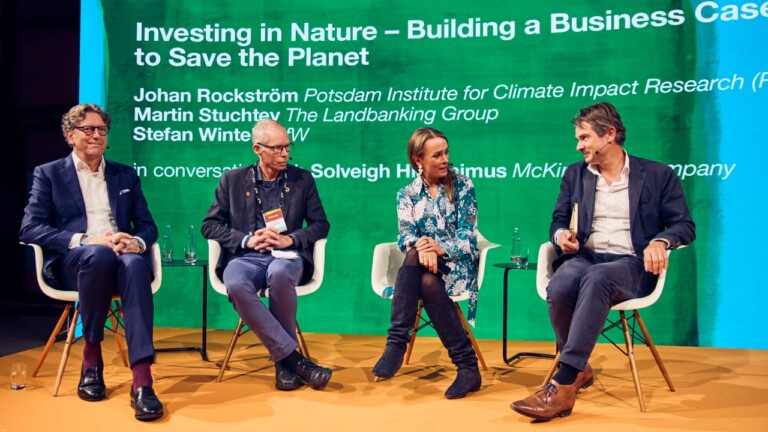
Investing in Nature: Building a Business Case to Save the Planet
Three leading experts from science and business discuss nature’s value for the global economy, highlighting the critical need to invest in nature conservation – because biodiversity loss is as significant a threat as climate change. Moderated by Solveigh Hieronimus (McKinsey & Company),…
Perspectives on Biodiversity
Loss of habitat, climate change, pollution, overexploitation of resources – these are some of the biggest issues we face today in terms of protecting nature and sustainability. Addressing these issues will require a multi-disciplinary and holistic approach. This DLD Munich session features…
