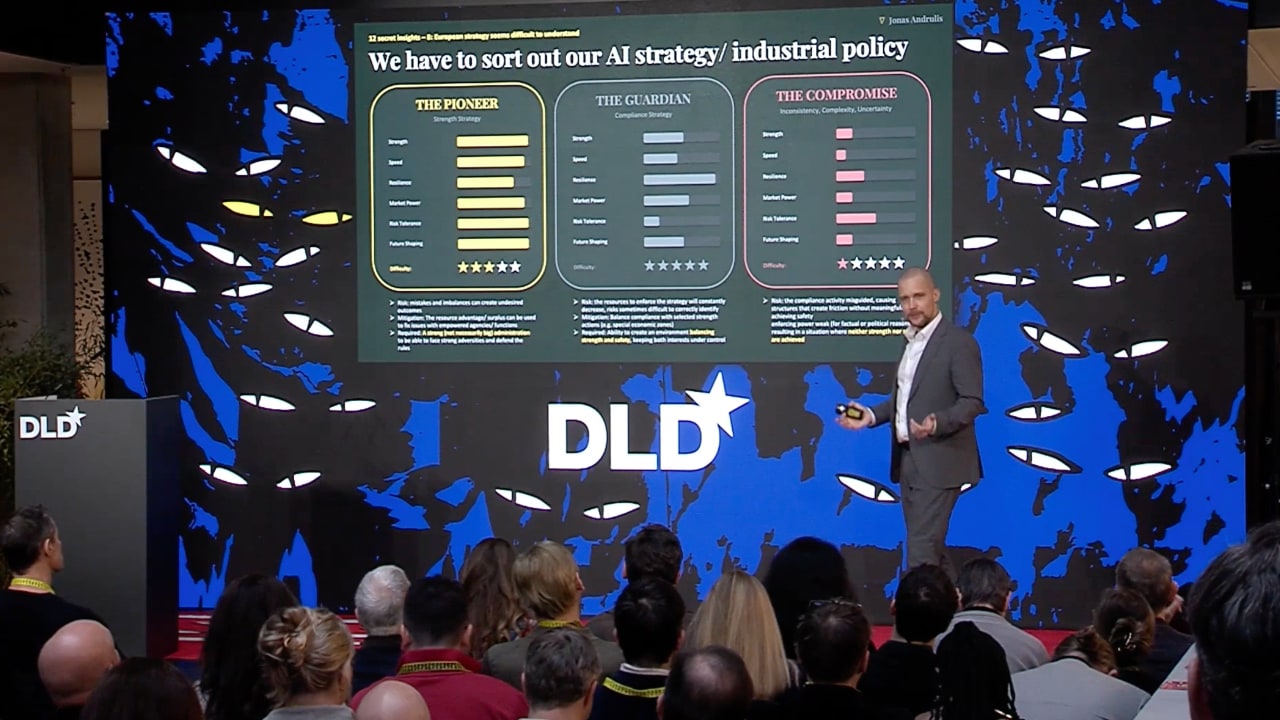
Artificial Intelligence is moving beyond a race for ever-larger language models and becomes a question of ecosystems, reliability, and human collaboration, Aleph Alpha founder Jonas Andrulis argues in his DLD Munich 2026 presentation.
In a rapid-fire presentation peppered with informative charts, Andrulis shares twelve insights from his experience of founding and leading Aleph Alpha, one of Europe’s most prominent generative AI ventures.
Andrulis opens with a striking visualization of why training LLMs remains an enormous challenge: the difference between stable and unstable training runs comes down to parameter variations as tiny as 0.0000001, he explains. “That’s the reason why even the best people, even the best labs, struggle to get predictable results.”
And merely having an LLM “is not sufficient as a business model”, Andrulis notes, because customers now choose ecosystems that combine models with tooling, data connections, filtering, and deployment infrastructure.
Andrulis also warns of a new workplace phenomenon called “work slop”, where employees use AI to produce “low effort, passable looking work that ends up creating more work for their co-workers.” The consequence is that “we need a new paradigm for human-machine collaboration”, Andrulis argues.
Watch the video for more insights.