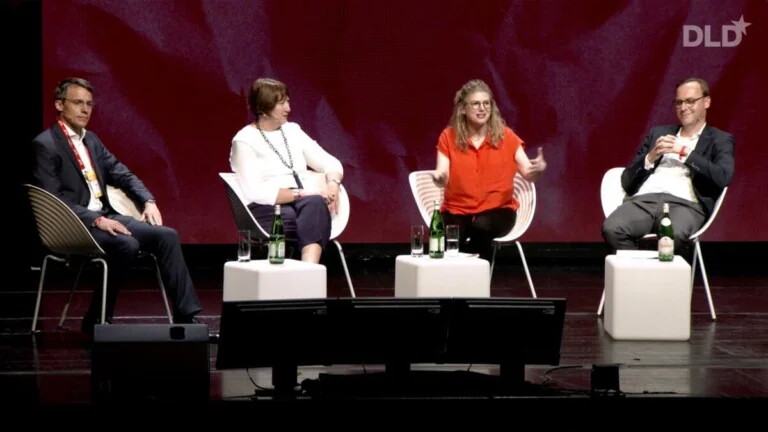
The real risk of AI may not be that it outsmarts us, but that it quietly erodes what makes human connections meaningful, as you’ll hear in this DLD26 expert panel discussion with Meredith Whittaker (Signal Foundation), Edward Harcourt (University of Oxford) and Bradley Horowitz (Wisdom Ventures), moderated by journalist Sibylle Anderl (DIE ZEIT).
When a chatbot generates a text stating “let me say ‘so sorry for your loss’”, the message loses some meaning, Edward Harcourt argues, because “the one thing it can’t be doing is commiserating, because it’s incapable of suffering. It can’t be born, it can’t die.”
Ultimately, we risk waking up “too late to what we’ve lost”, he warns, if we fail to understand “the value the co-presence of other humans makes for our lives.”
Meredith Whittaker warns of privacy issues that arise from agentic AI. “We are seeing a paradigmatic shift, I think, in computing history”, she says, as technology companies give AI systems access to user data on an operating-system level, whether users like this or not.
“This means critical infrastructure in the end is at stake”, she warns, “because data security is the basis of freedom – freedom of speech, freedom of information.”
Bradley Horowitz argues that there’s reason to be optimistic, not least because technology itself offers solutions. “I think we’re at a moment where technology, just like a thorn removing another thorn, can actually be applied to solve some of these biggest problems.”
Watch the video to explore this insightful session in detail.