

Courtesy of Tony Blair Institute
“Europe Has All It Needs to Become a Digital Superpower”
Keegan McBride, digital governance expert at the Tony Blair Institute, explains how Europe can catch up to China and the U.S. – and find strength in its diversity of cultures.
The digital age has not been kind to Europe, making the “Old Continent” literally seem dated and out of touch with fast-growing industries like artificial intelligence, cloud computing and social media. But is this common perception more than a cliché? Does Europe have hidden strengths that many people overlook?
Ahead of DLD26, we spoke with Keegan McBride, a Senior Policy Advisor for emerging technology and geopolitics at the Tony Blair Institute, about the continent’s competitive position. The former University of Oxford researcher is widely recognized as a leading voice in digital governance. As an American who has lived in the U.K., Estonia and Germany he brings a unique perspective to Europe’s position in the world.
In conversation with DLD, the 32-year-old explained why he believes that Europe has “all the ingredients of a digital superpower”, where the continent is already leading the way, and why Europe’s manufacturing expertise could give the region “more and more of an advantage.”
If digital infrastructure is of strategic importance, do we need to control the technologies we use?
Trying to do everything on your own for every important technology is not going to be possible – and in many cases, it’s also going to lead to more fragmentation, more risks, higher costs. I’m quite concerned with the growing call for a more protectionist approaches, which we’re seeing around the world. It’s happening in Europe, in China, in the U.S. So the real question is trying to understand where you want to have sovereign control, make the choices strategically. And for every country, that calculation is going to be different.
What does that mean for Europe?
Europe needs to understand where its strengths lie and ruthlessly prioritize growing these advantages. Economic supply chains have basically become new areas to exert influence, and Europe needs to be able to do the same. We’re seeing it happen with rare earth minerals in China, export controls on chips, things like that. But even countries that dominate the emerging tech stack will still have vulnerabilities throughout their economy.
DLD Munich 2026


A world of change is a world of opportunities. From January 15-17, 2026, you’ll get the chance to see and meet some of the most creative innovators in the world. DLD Munich 2026 brings together scientists and CEOs, inventors, founders, investors, politicians and creative minds from all over the world. Join us to discuss bright ideas for the world of tomorrow, make friends, and find new business partners. Our promise: “It’s gonna be wild!”
Can you name an example?
It’s very easy to see that the United States dominates consumer platforms like Amazon and Netflix; it dominates cloud computing, and it’s clearly the world’s superpower when it comes to AI. But you can also find clear dependencies on Europe – whether that’s semiconductors made by ASML in the Netherlands or precision optics made in Germany, which are needed for a lot of high-tech factory processes. And as AI starts to become further embodied in robots, Europe’s strength in manufacturing will give it more and more of an advantage.
How can Europe make the most of this opportunity?
Europe has all of the ingredients to turn itself into a digital superpower – but it has to want to do that. What we need is for Europe to step up. It needs to have a much bigger global footprint. It needs to acknowledge the growing importance of digital infrastructure and the broader technical stack as a means for creating digital power.
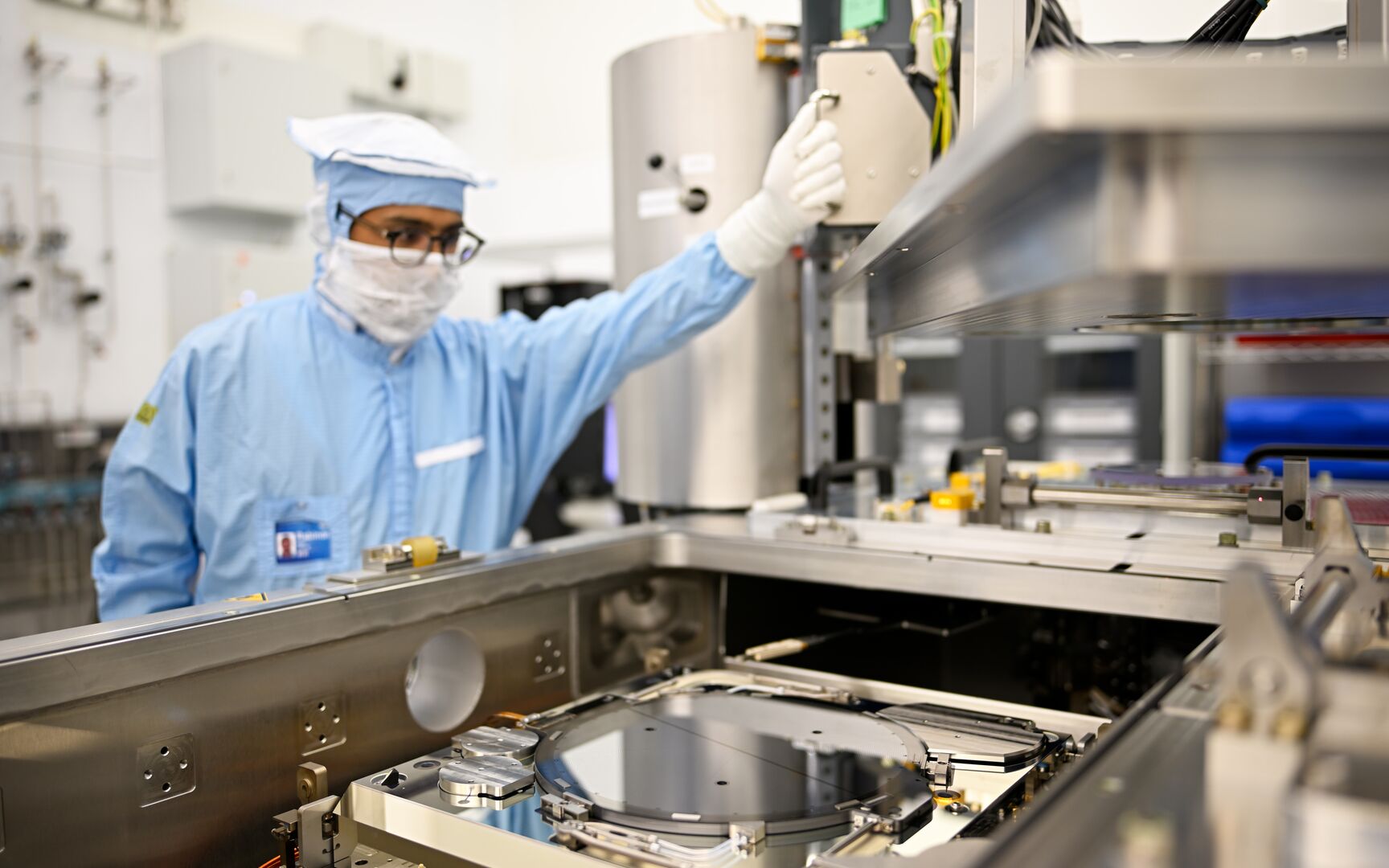
World-class technology: A worker inside a cleanroom at chipmaker ASML in Veldhoven, near Eindhoven. (Photo: ASML)
Europe as a digital superpower? That idea may surprise many people.
The EU Commission has been taking a lot of steps in the right direction, and while there’s much more that needs to be done, the continent actually has everything it needs to become a digital superpower. First off, you do have one of the world’s largest integrated single markets. You have multiple countries speaking multiple languages, multiple cultures that have managed to integrate and develop shared regulatory regimes. Effectively, Europe has regulated interoperability.
In addition, many of the world’s best startup ecosystems are in Europe. Many of the most innovative countries are in Europe. Many of the most competitive tax systems are in Europe. The world’s best digital governments are in Europe. They’ve already been thinking about digitalizing the public sector. They’ve already worked out how to do cross-border exchange of data, cross-border delivery of services. And if you look at where governments are using emerging technologies like AI, a lot of it is happening in Europe.
If that’s the case, why do so many people feel that Europe is falling behind?
Some countries, like Germany, definitely need to step up their game when it comes to digitalization. I lived in Berlin for a couple of years while working at the Hertie School Center for Digital Governance. The largely analog way of dealing with government services was incredibly frustrating after having lived in Estonia for about 10 years before. But Germany is slowly moving in the right direction now. Italy has done quite a lot in this regard, and of course, Norway, Denmark, Estonia – they’re all doing very well.
Yet every country seems to choose its own approach.
I’m going to steal something Tony Blair said in the year 2000. When he gave a speech about the EU in Warsaw he spoke about the importance of having a superpower not a super state. And I think this still holds true. Europe needs to act like an individual country, but it isn’t one. I don’t think the solution is to get rid of national borders and cultures and say, “Okay, we’re just going to be Europe now.” We do have to acknowledge that there are these individual member states with their own cultures, languages, histories, and values.
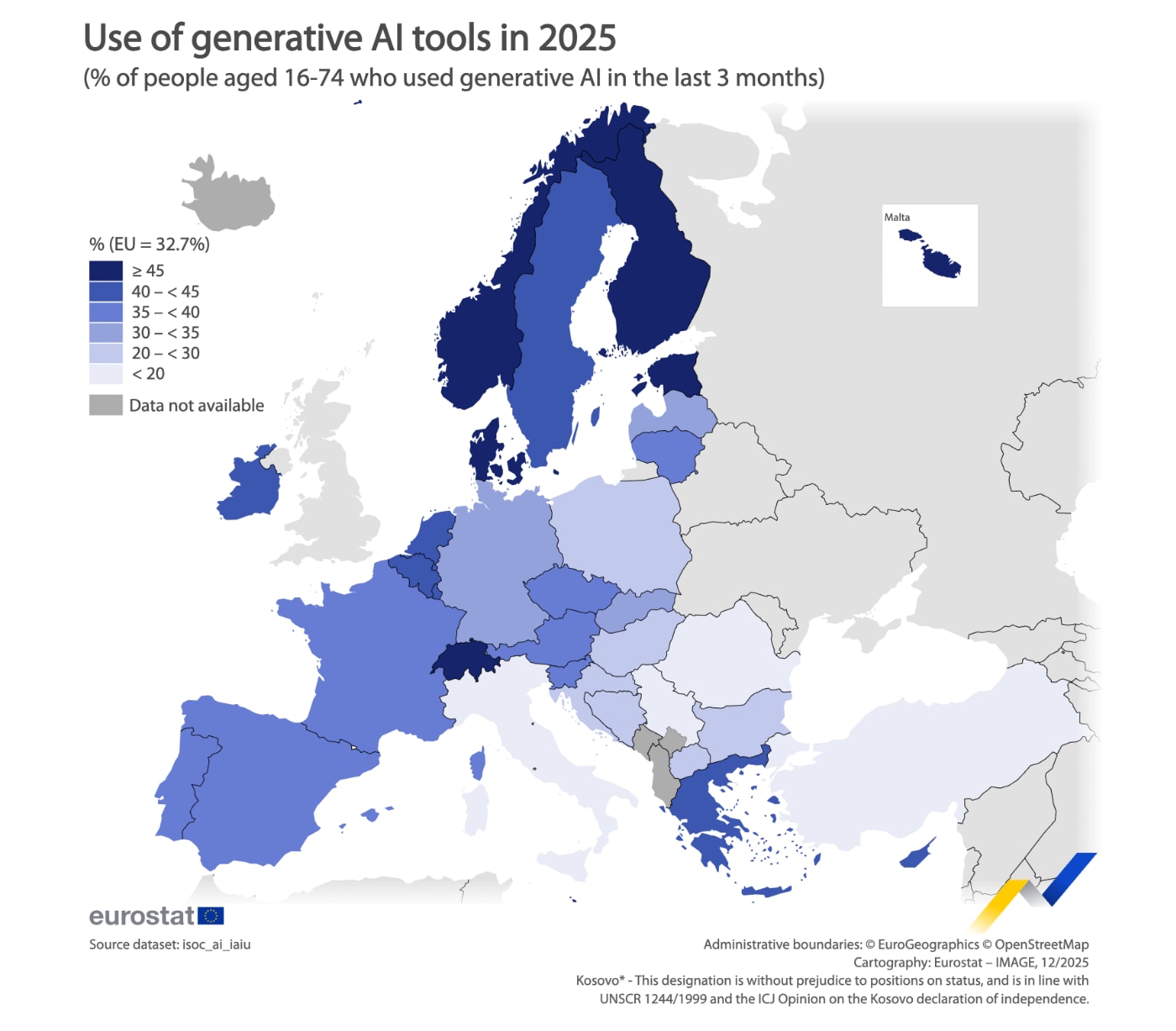
Different shades of generative AI: The use of chatbots and similar AI tools varies widely across Europe, data from Eurostat shows. On average one third of the population has made friends with ChatGPT & Co.
Where can the necessary unity come from?
There does need to be much more cohesion, for sure. If countries don’t want to work together, there needs to be more use of “coalitions of the willing” – you get a handful of countries who do believe in a common approach and are ready to align and to start moving. The pace of change in business and society is so fast at this point that a lot of the current processes to manage these conflicts are no longer fit for purpose. Something will have to change. Otherwise Europe is going to find itself in a spot that it doesn’t want to be in.
Where do you see the political will for this integration?
The difficult part about being a leader is that often you have to do things that are hard, and people don’t always care about them – but they’re necessary. That’s where we find ourselves. If you ask people, “What is the most important issue facing Europe today?” The bottom choice is digitalization of society, Eurobarometer polling shows. What these respondents don’t understand is that digitalization of society cannot be separated from everything else. If you don’t do this, you don’t have your pension, you don’t have nice healthcare, you don’t have great jobs.
Why is digital change not a priority for most Europeans?
At the moment, for many people, a lot of these risks haven’t become apparent. The status quo is not bad. In many places, there’s great quality of life, great healthcare, great education, and so on. But that’s not a given. And if you lose this innovation race, you’ll have a lot of people asking politicians, “You told us we shouldn’t do this, that we were doing just fine. How come we’re not?” And that’s when things will start to get really bad. That’s why we need leaders who understand the importance of technology, who understand the current geopolitical moment and who are willing to make the bold strategic choices that need to be taken in order to navigate that.

A question of priorities: In an October 2025 Eurobarometer poll, the majority of respondents want the EU to spend money on matters like employment, social affairs, public health, education, and defense. Digital infrastructure investments follow far behind issues like agriculture and immigration.
Your call for integration comes at a time when we see a renaissance of nationalism all over Europe.
Yes, part of this challenge means having to deal with the political reality that a growing number of the leaders in Europe are going to be on the center-right of the political spectrum. There is war in Ukraine. We do have a return to hard power. We do have a fracturing of the existing liberal order that has defined the last few decades. We do have growing protectionism and isolation. And we do see the strengthening of autocratic rulers, not just in Europe, but around the world. That is the world we live in. We can’t just sit and complain about it. If democractic leaders aren’t able to deal with that, we’re in trouble.
Do you see any connection between disenchantment with politics and the digital transformation?
People want things that work. And many governments aren’t working. For example, we have seen that when it comes to building trust in government, one of the most important things out there is delivery. Countries that have fully functioning digital governments, which are built with democratic values from the get-go, are able to deliver services more effectively, more efficiently. People are happier. You can see that in Scandinavia and the Baltic states, for example.
What about disinformation, particularly on social media and through AI?
It’s very easy to blame technology and say, “This is all bad, it’s horrible for democracy.” But the other side of the coin is: if your society is so fired up that a tweet can get thousands of people in the streets, willing to burn things down, then the problem was probably not the tweet. The problem was probably a breakdown within society that already happened.

Technology has great potential to make their lives better, many voters believe – but it needs to deliver. (Source: Disruptive Delivery: Meeting the Unmet Demand in Politics by the Tony Blair Institute)
How should governments respond?
We have to look at institutions. We have to look at the ability of governments to deliver. Safety is a big part of this. People want to feel secure – financially as well. They want feel that they have the opportunity to earn a good income, raise a family. If you can’t cover the basics, you’re in trouble. And technology plays a critical role in helping governments to deliver these basics.
We all use private sector services where things just work. And I think what governments need to understand is that this isn’t really an optional feature anymore. Digital services are critical to the way in which the world works. And if you don’t do it, you’re going to be left behind.
Meaning: embrace technology, speed up the digital transition?
The only way administrations can be capable of meeting people’s expectations is by fully leveraging the opportunity that technology brings. The problems are bigger than ever before. They’re more complex. They’re more integrated. They’re more global. And you have more of them happening, basically on a daily basis. At the same time, governments expect to do more with less. Many are cutting jobs across the board. They’re no longer competitive as an employer. That cannot work. Frankly, I feel that Europe, and the West in general, are not set up for the period we’re entering into.
It almost sounds as if you’re describing the motto of DLD26: “It’s gonna be wild.”
It is going to be wild. But I am an optimist. I want to see and believe that there’s a way out of this. Still, I think that the only way that we can do that is if we take an honest look at the situation, take stock of where we’re at. And many conversations fail to do that, which limits our ability to respond to the challenges we’re facing.
When I was teaching at Oxford, I had a slide asking, “Is democracy good?” Everybody just kind of laughed because the answer seemed so obvious. But we do have to seriously evaluate some of the things we take for granted. Democracy has not been the dominant form of government, except for maybe the last 60 or 70 years. Historically speaking, we’ve been living through a very abnormal period of time. Now we’re seeing a decline in democracy. We are retreating back to the world where the hard power reigns. And the only way to keep democracy strong is by committing to it, and fighting for it.
Related DLD Videos
A Push for Europe
How can Europe leverage its strength in science and research to become a global innovation leader? This DLD25 panel discussion, moderated by Stefan Drüssler (UnternehmerTUM), offers a range of different perspectives from EU Parliament Member Eva Maydell, German-American entrepreneur Cyriac Roeding, and…

Deep Tech in Europe
This DLD25 session highlights the challenges and opportunities for deep tech in Europe, focusing on funding, regulation, and ecosystem development. In conversation with moderator Mike Butcher (TechCrunch), Heike Freund (Marvel Fusion) and Philipp Herkelmann (EU Inc Petition) address Europe strengths in science…
