
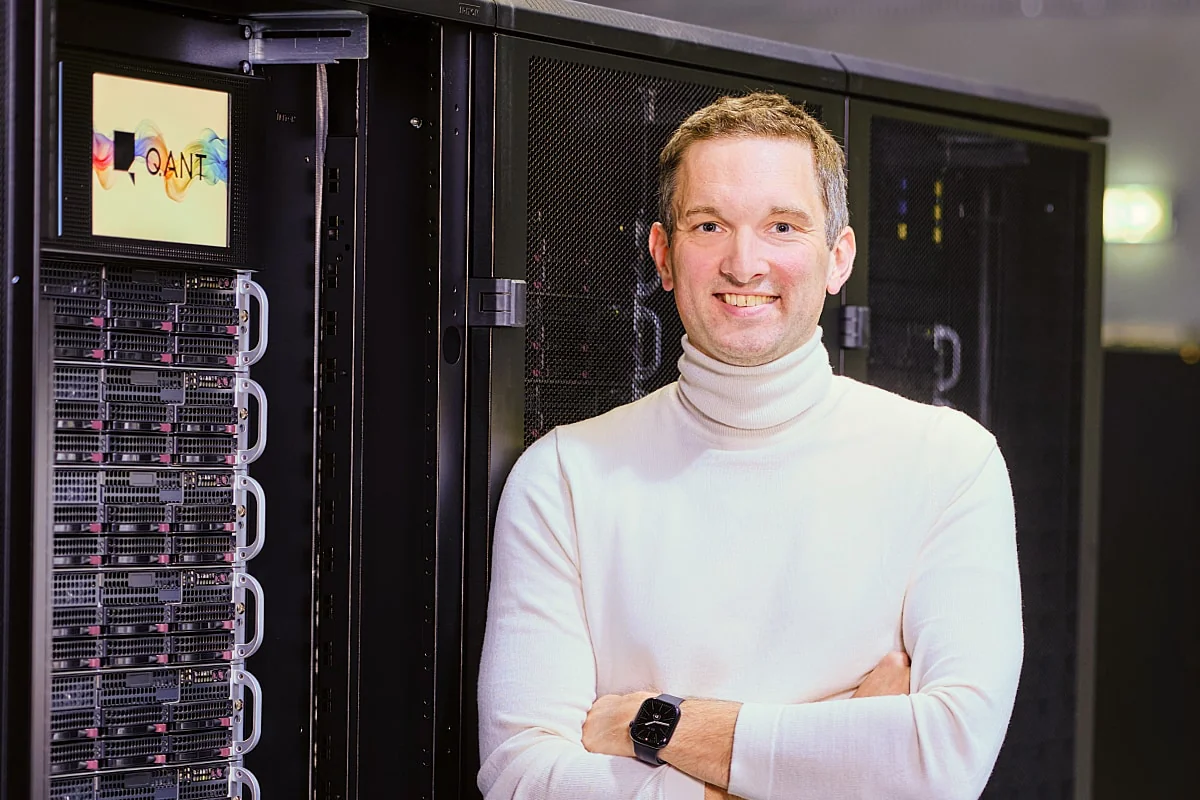
Image courtesy of Q.ANT
“AI is Pushing Today’s Chip Technology to the Breaking Point”
Michael Förtsch, Founder and CEO of Q.ANT, explains how optical computing can give AI a boost at much lower energy needs – and open up a whole new world of supercomputing.
Traveling at the speed of light is impossible – at least for humans. For photons, however, it’s a natural feat and promises to give computing an enormous boost. Imagine how much faster computers could become if they were able to use light instead of electric signals.
That’s what optical computing, also known as photonic computing, is all about. For decades, semiconductor chips became more powerful because developers managed to put ever more circuits into smaller and smaller spaces. But this seemingly automatic progress is hitting physical limits – right at a time when demand for computing power is skyrocketing, in large part due to the boom in Artificial Intelligence.
To Michael Förtsch, Founder and CEO of German deep-tech startup Q.ANT, the solution is clear: replace electricity with light, and computers will not just be able to run faster but perform heavier tasks with less energy, as he explains in conversation with DLD. The company’s name, by the way, is derived from the words “team, anticipation, novelty, and quality”, spelled backwards. It’s not meant as a reference to quantum computing, as Förtsch made clear in his DLD Munich 2026 session with Christian Teichmann of Burda Principal Investments. (Video here.)
You speak of photonic computing as a “new beginning” for computing. Why?
It’s pretty straightforward: AI is pushing today’s chip technology to the breaking point. Each new generation of GPUs, the graphics processors best suited to AI, uses more power and generates more heat. A single GPU consumes about 1.2 kilowatts – that’s like running a kitchen oven continuously. Now imagine thousands of those chips running day and night in a data center. Energy becomes the bottleneck, not compute power. If we keep going this way, AI’s business model simply won’t work.

Michael Förtsch
studied mathematics and physics, earning his doctorate at the Max Planck Institute for the Science of Light in Erlangen, where he received the Otto Hahn Medal for his achievements in quantum information processing. He founded Q.ANT in 2018 to develop novel photonic sensors and computer chips.
Speaker ProfileDo we need a different approach for AI?
It’s not the technology’s fault. Traditional semiconductor circuits, known as CMOS, are fantastic, but we’re using them for the wrong job. It’s like hammering in a screw: you can do it with brute force, but why not just use a screwdriver?
That’s exactly what we’ve built at Q.ANT. Our photonic co-processors can run AI computations much faster and more efficiently using different math, and that math runs best on analog photonic circuits that compute with light instead of electricity. These chips can also save up to 30 times the energy and deliver 50 times higher performance for complex AI workloads.
How is this possible?
Because light travels faster, generates almost no heat, and a single optical element can do what takes thousands of transistors in a CMOS chip. This unlocks applications that are simply too expensive or complex today – physical AI, advanced robotics, scientific simulation. Or, in a more practical example, just imagine you can generate a new movie from a text input – instantaneously. Which, again, CMOS can’t do.
But the real new beginning goes beyond just new hardware. We need to rethink the entire computing stack. The future won’t rely on one technology solving everything. Instead, we’ll see different technologies working together – digital and analog, GPUs, CPUs, photonic processors, and eventually quantum processors.
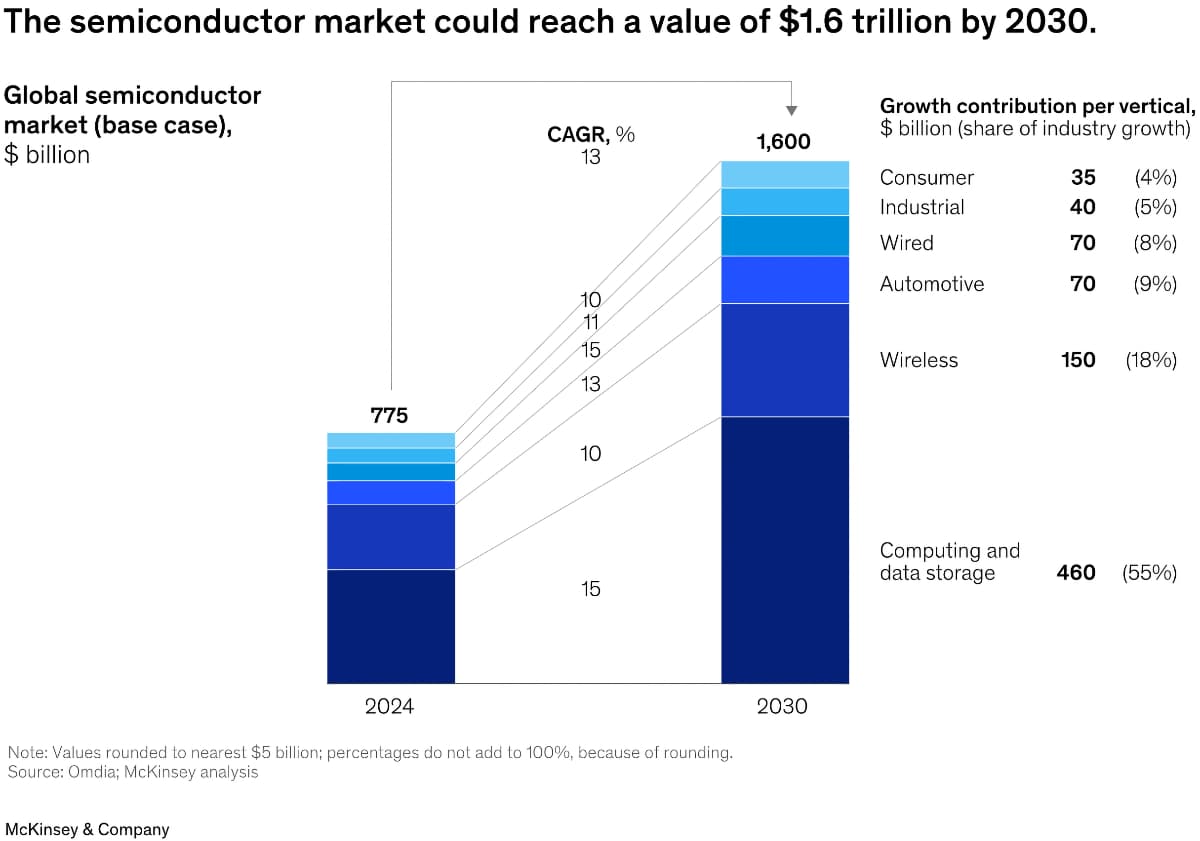
Small chips, big business: A new McKinsey report projects the worldwide semiconductor market to reach a value of $1.6 trillion annually by 2030.
Which applications will benefit most?
The next wave of AI will extend far beyond what we see today. It will go beyond Large Language Models. It will be shaped by advances in simulation, visual AI and other complex applications. The biggest boost from photonic computing will come in exactly these applications that rely on complex, nonlinear computation, such as computer vision, robotics and advanced simulations. Digital processors are designed for linear computation, so they need millions of operations to achieve what a photonic processor can do in a single optical step. This is what dramatically cuts energy use while unlocking entirely new AI capabilities.
What about industrial applications?
In areas like manufacturing, logistics, or inspection, photonic processors allow visual AI to detect defects, track objects, and optimize inventories with fewer model parameters, making computer vision economically viable, even for tasks that were previously considered too compute-intensive on digital hardware. Photonic processors will also accelerate the next generation of AI architectures, for example hybrid models that combine statistical reasoning with physical modelling. This will advance domains such as drug discovery, materials design, and adaptive optimization, where nonlinear complexity and extreme energy efficiency are essential.

Inner values: From the outside, Q.ANT’s first photonic processor may look familiar – but it uses light instead of electric impulses for computing tasks. (Image: Q.ANT)
Are your processors available yet?
Yes, they are. Our customers, R&D Supercomputing centers and early adopters in the industry, can order Q.ANT servers equipped with the latest processor generation now, and shipments will start in the first half of 2026. In two of Europe’s leading supercomputing centres, our processors are already deployed: at Leibniz Supercomputing Centre (LRZ) and Jülich Supercomputing Centre (JSC) – with further installations to be announced soon. To keep this momentum, we’re soon giving early adopters in the research and open-source community access to our technology so they can experiment with our hardware and develop algorithms, functionalities and applications.
How quickly is the technology evolving?
Photonic computing is scaling much faster than CMOS. With photonics, we have achieved significant performance leaps in one year that took a decade in digital computing. We released our first processor generation in November 2024 having a performance equivalent to an Intel Pentium from the 1990s. In November 2025, we launched our second processor generation with a performance equivalent to an Intel Pentium 4 from the year 2000. It‘s a bit of a tricky comparison, though, because these performance benchmarks were developed for traditional chips, they consider only linear math. If we compare the performance using more advanced mathematical functions, we are already state-of-the art.

Michael Förtsch
Founder & CEO Q.ANT
“I’m confident that Europe can become a champion of deep tech – especially now, with the opportunity to pioneer a completely new computing paradigm.”
What sets Q.ANT apart from other companies in photonic computing?
Six years ago, we made a bold bet against the market by developing a unique, patented material platform for our chips – a strategic move that is now paying off. We manufacture our chips in our own pilot line, built on retrofitted 1990s semiconductor equipment, which democratizes access to cutting-edge chipmaking without requiring multi-billion-dollar investments in new facilities. By keeping the entire value chain in Europe – from wafer production to chip design to industry-ready processors – we ensure independence and agility.
How difficult was it to get funding for a pioneering technology?
Our funding approach was unique. Throughout the initial development phase, we effectively had a single investor: our longstanding partner TRUMPF. During that phase, we were able to demonstrate the fundamentals of our chip technology, including the build-up of our own chip production pilot line in Stuttgart. Once we were able to switch from the technological to the product development phase, we expanded our investor base. Naturally, fundraising is never easy. But in July 2025, we closed Europe’s largest Series-A funding round in photonic computing. For me, this showed that Europe has the strength to lead in key technologies.
Do you see this as a sign that Europe will be able to stand up to China and the U.S. in your field?
I’m confident that Europe can become a champion of deep tech – especially now, with the opportunity to pioneer a completely new computing paradigm. Unlike the U.S., Europe does not have large, established cash cows that tie us to old technologies in the computer industry. This gives us the freedom to innovate and leap ahead. In my opinion, the key is speed and courage: Europe needs to focus on technologies that create real value, not just try to catch up with the U.S. or China. We have many champions across different industries – we now need to demonstrate that we trust in our own technologies and start using it, for example by giving preference to EU hardware in AI gigafactories. In my opinion, this is the only chance to protect our prosperity.

When Algorithms Start Running on Light
Michael Förtsch, Q.ANT, and investor Christian Teichmann, Burda Principal Investments, discuss the revolutionary potential of optical computing at DLD26.
WatchBy loading the video you agree to the privacy policy of Youtube.
You are currently viewing a placeholder content from YouTube. To access the actual content, click the button below. Please note that doing so will share data with third-party providers.
More Information